
The protein powder market is one of the most crowded in nutrition. Hundreds of products, near-identical claims, and very little transparency about what actually separates a good product from a mediocre one. This guide cuts through that. What protein is, why consistent daily intake matters, what to look for on the label, what to avoid, and how Protein Works approaches each of those questions.
Here’s the short answer before we get into the detail: the quality of a protein powder comes down to four things – the completeness of its amino acid profile, its purity and ingredient quality, whether it actually tastes good enough to use consistently, and how well it fits into your daily nutrition. Let’s break all of it down.
What Protein is and Why Your Intake Matters
Protein is one of the three core macronutrients – alongside carbohydrates and fats – and it’s involved in virtually every structural process in the body. The UK Reference Nutrient Intake (RNI) for protein, set by the Committee on Medical Aspects of Food Policy (COMA) and upheld by the Scientific Advisory Committee on Nutrition (SACN), is 0.75g of protein per kilogram of bodyweight per day for adults. [1]
In practice, many people could benefit from more than this depending on their lifestyle and activity level. Research suggests that depending on how active you are, a meaningful daily target can range from 1.2g to 2.2g of protein per kilogram of bodyweight. [2] For example, if you weigh 85kg and are moderately active, aiming for 1.2g per kilogram of bodyweight would mean a daily target of around 102g of protein.
Protein is built from amino acids. There are 20 amino acids involved in human biology, of which nine are classified as ‘essential’ – meaning your body cannot produce them and must obtain them from food. These nine are: histidine, isoleucine, leucine, lysine, methionine, phenylalanine, threonine, tryptophan, and valine. A protein source that contains all nine in sufficient amounts is called a ‘complete’ protein.
Why does consistent intake matter? Because protein isn’t stored in the body the way other macronutrients are. Your body is constantly breaking down and rebuilding protein tissues, and it needs a regular supply of amino acids to do so. Most people know, in theory, that protein is important. The challenge is consistently hitting a meaningful daily target through diet alone – particularly with busy schedules and variable meal quality. That’s the practical problem a protein powder can help solve.
Whey vs Plant Protein: the Key Difference
Whey protein naturally contains all nine essential amino acids in a well-balanced ratio, making it the reference standard for protein quality. Plant-based proteins are more variable. Single plant sources often fall short on one or more essential amino acids – pea protein is lower in methionine, rice protein is lower in lysine. This is why multi-source blending matters in a plant-based product. A well-formulated vegan protein will combine multiple plant sources to compensate for individual shortfalls and deliver a complete amino acid profile.
How a Quality Protein Powder Fits into Daily Nutrition
A protein powder is a nutritional tool – one that makes it easier to hit a daily protein target regardless of what the day looks like. It can be a shake between meals, mixed into cooking or baking, or used to supplement a meal that’s lower in protein than usual. The products that do this best are versatile, convenient, and actually enjoyable to consume.
The quality of the shake matters more than most people realise. A product that tastes unpleasant or mixes badly gets used inconsistently – and inconsistency is where the value disappears. This is one reason the Protein Works range invests heavily in flavour development: every flavour is curated by an in-house team of nutritionists and in-house specialists. At GOLD and PLATINUM tiers, Premium Flavours are available too – next-generation flavour recipes offering a multi-dimensional flavour experience, from Blueberry Cheesecake Riot to White Chocolate Raspberry Swirl.
The 360 concept that underpins the Protein Works protein range reflects this approach. Nutritional content, ingredient quality, product efficacy, and taste and texture – all considered together, not traded off against each other.
What to Look For on the Label:
When evaluating a protein powder, here are the things that actually matter – and what to look for in each.
- Protein per Serving
The first question is simple: how much protein is in this? In a protein shake, aim for anywhere between 18–25g per serving. For the Whey Protein 360 range: BLACK delivers 18g per serving, GOLD delivers 20g, and PLATINUM delivers 24g – all from premium-grade multi-sourced whey protein blends.
- Number of Protein Sources
BLACK and GOLD use a tri-blend of three whey protein sources, enabling an advanced phased release of nutrients. PLATINUM adds a fourth source – whey protein isolate, one of the purest forms of whey – creating a quad-blend.
- Vitamins and Minerals
This is where real differentiation between tiers shows up. BLACK is a pure premium protein with no added vitamins or minerals. GOLD includes 12 vitamins and minerals, unlocking 87 EU-approved science-backed health benefits per shake. PLATINUM includes 26 vitamins and minerals – more than double GOLD – delivering 166 EU-approved health benefits per serving.
- Digestive Support
Both GOLD and PLATINUM include Digezyme® – a multi-enzyme complex clinically formulated to support the breakdown of key macronutrients including protein, and to aid their absorption. PLATINUM goes further with the addition of probiotics at 10.5 million CFU per serving, designed to promote a healthy gut microbiome.
- Omega 3 and Electrolytes
At PLATINUM, the formulation includes Omega 3, which contributes to the maintenance of normal blood cholesterol levels – an EU-approved health claim. Electrolytes at PLATINUM (sodium, potassium, and magnesium, all at a minimum of 15% NRV) support normal daily hydration and function.
- Added Sugar
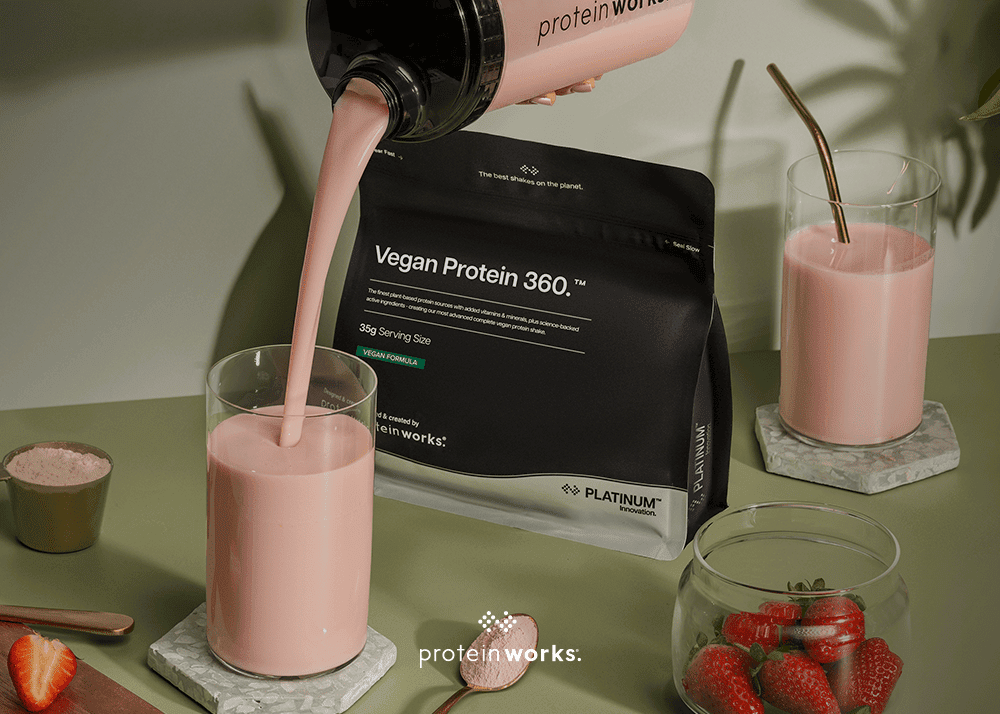
All three tiers of the Whey Protein 360 contain no added sugar. The Protein Works plant-based 360 range – Vegan Protein 360 – also follows the same tier structure.
What to Avoid
- Excessive added sugar – check the carbohydrate breakdown and look specifically at the ‘of which sugars’ figure. Added sugar adds calories without adding nutritional value.
- Single-sourced protein – a single protein source, even a good one, delivers a less sophisticated nutritional profile than a well-designed multi-source blend. The phased nutrient release from a tri- or quad-blend is a meaningful formulation advantage.
- No digestive or micronutrient support – protein shakes have evolved significantly. If you’re looking for a product that’s above entry-level, you should expect some form of digestive or micronutrient support alongside the protein.
How Protein Works Approaches Protein
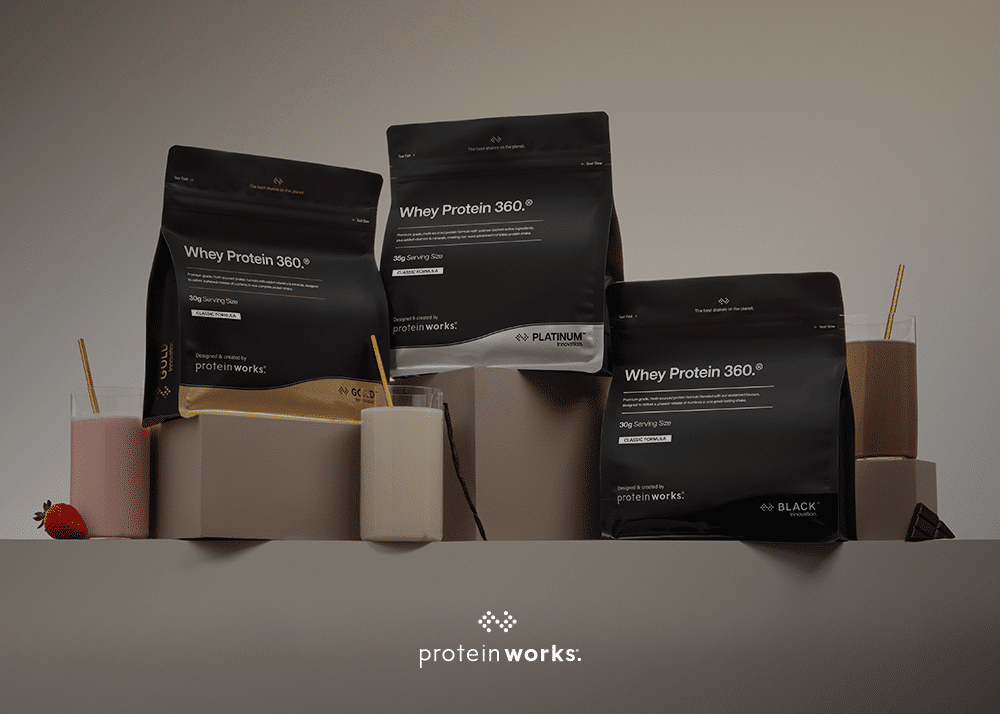
The Protein Works protein range is structured around the 360 concept and built across three innovation tiers, each designed for a different starting point and different nutritional goals.
- Whey Protein 360 BLACK – premium-grade tri-blend, complete amino acid profile, all nine essential amino acids, no added sugar. 18g protein per serving, 110 calories, five flavours. The benchmark for what a pure, transparent protein powder should look like at exceptional value.
- Whey Protein 360 GOLD – the same premium-grade tri-blend base, with 20g protein per serving, 12 vitamins and minerals, Digezyme® for digestive support, and 87 EU-approved health benefits per shake. Eight flavours including two Premium Flavours.
- Whey Protein 360 PLATINUM – the most advanced formulation in the range. Quad-blend including whey protein isolate, 24g protein per serving, 26 vitamins and minerals, Digezyme®, 10.5 million CFU probiotics, Omega 3, electrolytes, and 166 EU-approved health benefits. Twelve flavours including four Premium Flavours. 125 calories per serving.
Every product is formulated in the UK. Every flavour is developed in-house. The same standard – outstanding nutritional content, ingredient quality, efficacy, and taste – applies across all three tiers.
That’s everything you need to know to choose the best protein powder in 2026. Got questions? Reach out to us on Instagram, TikTok, or Facebook.
Explore the Protein Works Protein powder range
Browse the full Whey Protein and Vegan Protein range.


References
- UK Reference Nutrient Intake (RNI) for Protein
Committee on Medical Aspects of Food Policy (COMA). Dietary Reference Values for Food Energy and Nutrients for the United Kingdom. Department of Health Report on Health and Social Subjects No. 41. London: HMSO, 1991. Upheld and maintained by the Scientific Advisory Committee on Nutrition (SACN).
nutrition.org.uk — Protein: Reference Nutrient Intake
- Protein Intake Ranges for Active Adults
Morton RW, Murphy KT, McKellar SR, et al. A systematic review, meta-analysis and meta-regression of the effect of protein supplementation on resistance training-induced gains in muscle mass and strength in healthy adults. British Journal of Sports Medicine. 2018;52(6):376–384.
DOI: https://doi.org/10.1136/bjsports-2017-097608