

Starting GLP-1 Medications? Here’s How to Keep Your Nutrition on Track When Appetite Changes

GLP-1 agonists have taken the world by storm. These medications, originally developed for type 2 diabetes, are now widely used for weight loss. Approximately 1.6 million people in Great Britain are starting GLP-1 medications, with roughly 910,000 using them exclusively to lose weight. And a further 3.3 million people say they’re interested in trying them within the next year.[1]
At Protein Works, nearly 20% of customers with a weight loss goal are currently using GLP-1 medication.
On average, GLP-1 medication can lead to a 15-25% decrease in body weight in a year.[2] But while weight loss results may be impressive, research also shows that the use of GLP-1 agonists is associated with significant muscle loss and an increased risk of nutritional deficiencies.[3][4]
With usage growing rapidly, and the nutritional implications becoming clearer, here’s what you need to know about GLP-1s. This article explores how they work, the challenges they pose, and how Protein Works can help support your nutrition at every stage.
 What is GLP-1?
 What is GLP-1?
GLP-1 (glucagon-like peptide-1) is a hormone released in the gut after eating. It triggers the release of insulin, which helps to regulate blood sugar levels.[5] It also reduces gut motility, so food passes more slowly through the digestive tract, and it helps to regulate food intake and appetite.[6]
These effects are why GLP-1-based medications have become so widely used for diabetes and weight management.
What are GLP-1 Agonists?
GLP-1 agonists mimic the effects of GLP-1, helping to regulate blood sugar levels, slow gastric emptying and reduce appetite.[7] By reducing hunger and increasing fullness, they make it easier to eat fewer calories, which is why they are now commonly used for weight loss.
The most widely used GLP-1 medications include:
- Semaglutide: a pure GLP-1 agonist found in Ozempic (for diabetes) and Wegovy (for weight loss).[8]
- Tirzepatide: a dual GLP-1/GIP agonist used in Mounjaro. The added GIP (glucose-dependent insulinotropic polypeptide) action may offer enhanced benefits for blood glucose control, appetite regulation and weight management.[9][10].
- Liraglutide: another pure GLP-1 agonist used in diabetes and weight-loss treatments [8].
Common Side Effects of GLP-1
Common side effects across all types of GLP-1 agonists include:
- Diarrhoea
- Gastrointestinal discomfort/disorders
- Nausea
- Vomiting
- Lethargy
- Dizziness
- Constipation
- Risk of both low and high blood sugar[11][12]
Smaller, more frequent meals may help manage symptoms such as nausea, particularly in the early days of treatment.[3]
Nutritional Challenges While Using GLP-1 Medication
GLP-1 medications work primarily by reducing appetite and slowing digestion, which makes it easier to eat less and consume fewer calories. However, these changes can introduce several nutritional challenges.
Nutrient Deficiencies
When using GLP-1 medication, people tend to eat smaller, less calorie-dense meals.[13] In fact, studies show daily calorie intake drops by around 13-24%, and up to 35% in a single meal [14][13]. When calorie intake falls below 1200 kcal/day for women or 1800 kcal/day for men, the risk of micronutrient deficiency increases significantly.[3]
Those with obesity are more likely to have lower diet quality to begin with, and differences in nutrient absorption and metabolism, increasing their risk of micronutrient deficiencies.[3]
At-risk nutrients include:
- Fibre [4]
- Micronutrients, particularly calcium, iron, magnesium, potassium, choline, and vitamins A, C, D and E.[4]
- Protein on g/kg/d basis. Higher protein intake is recommended during weight loss to help preserve lean muscle mass.[4][15]
- Healthy fats, particularly an optimal ratio of unsaturated to saturated fats.[16]
Underconsumed Food Groups
Research shows that many people using GLP-1 medication also fall short on several key food groups.
Food groups that often fall below recommended daily levels include:
Dehydration
People also often experience reduced thirst while taking GLP-1 medication. A combination of gastrointestinal symptoms, reduced appetite and reduced fluid consumption puts many at risk of dehydration, though clinically significant electrolyte imbalances are rare.[17]
How Protein Works Can Support Those Using GLP-1 Medication
Because GLP-1 medication can make it harder to meet your nutritional needs, choosing products that are easy to digest and nutritionally dense can make a significant difference.
Many people report being able to tolerate liquid nutrition more easily than solid food, especially in the early days of GLP-1 treatment when symptoms tend to be worse. Liquids – be that soups, smoothies, protein shakes or meal replacements – can pass through the gastrointestinal tract faster, feel less heavy and are easier to finish, though they are typically less satiating, so balanced solid meals are still important.
Supplements can also play a useful role in topping up nutrients that are harder to obtain during periods of reduced appetite.
Here are just some of our products that can support you while you’re using GLP-1 medication:
Complete Meal 360
Complete Meal 360 comes in a liquid format that many find easier to tolerate when they have a reduced appetite or are experiencing gastrointestinal symptoms. It helps support sufficient calorie intake throughout the day and provides a balance of high protein, high fibre and low sugar. As a source of dairy and a blend of vitamins and minerals commonly at risk of deficiency, it can help cover important nutritional bases.
Diet Meal 360 & Vegan Diet Meal 360
Genesis Advanced Hydration is formulated with key micronutrients that are often under-consumed during GLP-1 use, including potassium, magnesium, calcium and vitamin C. It also supports daily hydration, helping to lower the risk of dehydration while contributing valuable minerals.
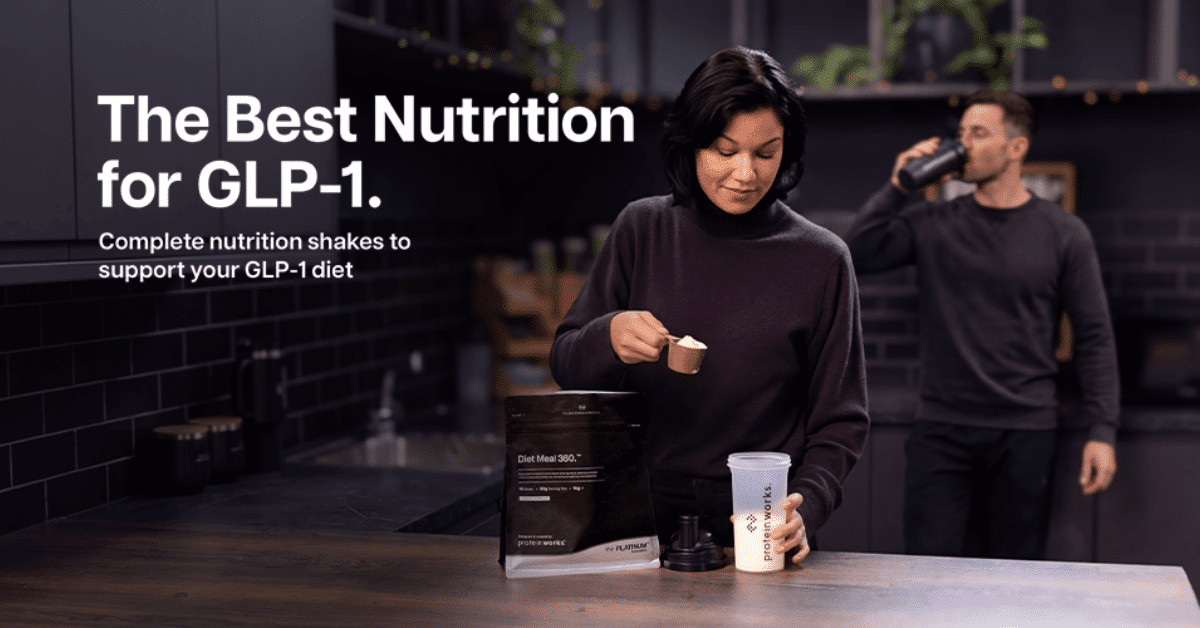
Both Diet Meal 360 and Vegan Diet Meal 360 shakes are perfect for anyone following a GLP-1 diet, designed as a nutritionally complete, low calorie meal shake that contains at least 160 EU-approved health benefits and scientifically-backed premium ingredients.
Protein Shakes
Protein Works’ whey and vegan protein shakes offer a simple way to increase protein intake and support muscle health when your appetite is reduced. Some innovation levels are fortified with additional vitamins and minerals, and several provide a source of dairy, helping to boost nutrient intake during periods of reduced food consumption.
How Protein Works Can Support Those Stopping GLP-1 Medication
Weight regain is common after stopping GLP-1 medication.[19] This is largely due to adaptive thermogenesis – a natural slowing of your metabolism that happens during weight loss, meaning your body burns fewer calories than before.[20][21]
But research shows that weight regain is not inevitable. To keep the weight off long-term, people usually need ongoing calorie restriction and professional support, including dietary intervention, regular supervised exercise and behavioural support.[22][23][24] Behavioural intervention is particularly key to long-term success, and ideally should begin to be implemented during the weight loss phase.[24]
As part of the initial transition when stopping GLP-1 medication, Protein Works’ Diet Meal 360 – GOLD can be used as an aid. It provides a lower-calorie option to help manage overall calorie intake when coming off GLP-1 medication. It’s high in protein and fibre, low in sugar, and contains an extensive range of vitamins and minerals to support your transition.
It’s important to seek professional dietary and lifestyle support alongside GLP-1 medication for the most effective long-term outcome.
The Take Home
GLP-1 agonists can be highly effective for weight loss, but they also create unique nutritional challenges. Protein Works can support your nutritional needs throughout your GLP-1 journey, with a range of supplements, meal replacements and protein shakes designed to boost nutrient intake, maintain energy and support overall wellbeing.
For the best long-term results, combine balanced nutrition with personalised guidance from a healthcare professional.
For more information on weight loss and weight management, check out our guides on Strategies for Weight Management, Tips for Controlling Hunger Cravings and How Meal Replacements Keep You Feeling Full.
Alternatively, learn more about how we can support a GLP-1 diet and lifestlye.


References:
[1] https://www.medrxiv.org/content/10.1101/2025.06.06.25329114v1.full
[2] https://pubmed.ncbi.nlm.nih.gov/40149944/
[3] https://pubmed.ncbi.nlm.nih.gov/40452753/
[4] https://pubmed.ncbi.nlm.nih.gov/40352260/
[5] https://pubmed.ncbi.nlm.nih.gov/31636017/
[6] https://pubmed.ncbi.nlm.nih.gov/17928588/
[7] https://pubmed.ncbi.nlm.nih.gov/32910490/
[9] https://pubmed.ncbi.nlm.nih.gov/40221292/
[10] https://pubmed.ncbi.nlm.nih.gov/38976257/
[12] https://bnf.nice.org.uk/drugs/tirzepatide/
[13] https://pubmed.ncbi.nlm.nih.gov/28266779/
[14] https://pubmed.ncbi.nlm.nih.gov/40259488/
[15] https://pubmed.ncbi.nlm.nih.gov/26883880/
[16] https://www.sciencedirect.com/science/article/pii/S2667368125000397
[17] https://pubmed.ncbi.nlm.nih.gov/40507203/
[18] https://pubmed.ncbi.nlm.nih.gov/38879135/
[19] https://pubmed.ncbi.nlm.nih.gov/40186344/
[20] https://pubmed.ncbi.nlm.nih.gov/20935667/
[21] https://www.mdpi.com/2072-6643/17/16/2699
[22] https://pubmed.ncbi.nlm.nih.gov/38421559/


